
What Is a Russian Manicure?
April 12, 2026
Lash Extensions vs. Lash Lifts: Which Is Right for You?
July 20, 2026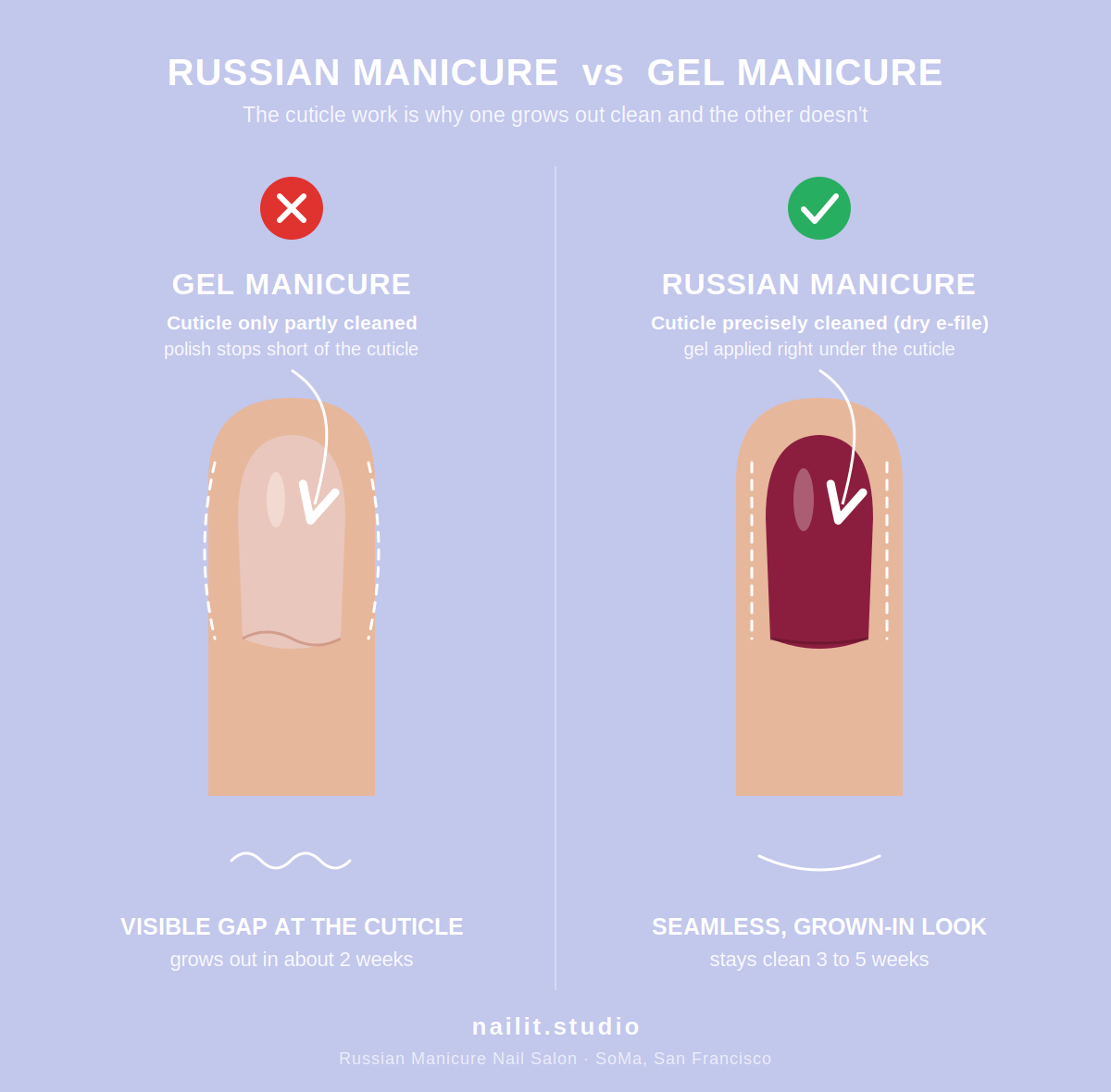
A client sat down last week, turned her phone around to show me a photo, and asked whether a Russian manicure was “basically just gel.” I hear it almost every day. And honestly, I get why. Side by side in a picture, the two really can pass for the same thing. They’re not. What separates them is the one part of the job that never makes it onto a price list: how the nail gets prepped before any color touches it.
Here’s how I explain it to clients.
The short answer
Start with gel. A gel manicure is about the color, really, gel pigment cured rock-hard under a UV or LED lamp so it outlasts ordinary polish. A Russian manicure is a different animal. The word “Russian” has nothing to do with the shade you pick. It describes the prep, the slow, dry, e-file cuticle work that happens before the first coat ever goes on.
That trips people up, so let me put it plainly: you can absolutely get a Russian manicure with gel on top. One word is about the product. The other is about the technique.
The core difference: wet prep vs. dry prep
In a standard gel manicure, your hands soak, someone pushes back or snips the cuticle, and the gel goes on a touch away from the skin so it won’t pool. Quick. Looks good for a week, maybe two.
My process looks different from the first minute. No water, none. I work dry, with an e-file (electric file) and a set of bits, lifting away only the dead tissue around the nail. The living skin, the eponychium, stays exactly where it is. I never touch it. Because the plate is dry and spotless, I can lay the gel right up under the cuticle line, and that single detail is why the finish reads almost airbrushed, and why it grows out without that telltale gap.
| Gel Manicure | Russian Manicure | |
| Prep method | Soak, push back / trim cuticle | Dry, e-file cuticle work (no soaking) |
| Gel placement | Slightly away from cuticle | Right under the cuticle line |
| Time in chair | 30 to 45 minutes | 90 minutes to 2 hours |
| Typical wear | 2 to 3 weeks | 3 to 5 weeks |
| Grow-out look | Visible gap within days | Clean, “grown-from-the-nail” line |
| Focus | Color and speed | Precision and natural-nail health |
| Skill required | Standard training | Advanced, specialized training |
Why a Russian manicure lasts longer
People assume longevity is a polish-brand thing. It isn’t, not really. It comes down to the prep. A clean, oil-free plate grips gel far better, and there’s simply no gap at the cuticle for water or air to creep under and start the lifting. Seal that edge properly and you buy yourself weeks. I’ll have a client back at four weeks with the color still sitting tight, when the same person used to spot chips by day ten at her old salon. If you want the nuts and bolts of how the technique works, I broke it all down in my guide to what a Russian manicure actually is.
Let’s talk cost, honestly
Yes, it costs more, and I’d rather be upfront about that than dance around it. You’re paying for double the chair time, for training most technicians never complete, and for the e-file and sterilization setup behind the table. Around San Francisco, expect somewhere in the $90 to $150 range for Russian work, against roughly $55 to $75 for a standard gel manicure.
What about safety?
This is the question I actually like getting, because the technique really can go wrong in the wrong hands. Working that close to the cuticle takes training. The American Academy of Dermatology warns against hacking away at cuticles for good reason, and a handful of states even regulate it. Done right, I’m only lifting dead tissue, every tool that comes out of the pouch is sterilized, and your nails get healthier month over month. Done by someone who grabbed a drill for the first time last Tuesday, it can thin the plate or leave the skin raw. So my honest answer is this: the method is safe. The person holding the e-file is the part that matters.
So which one should you choose?
Go with a gel manicure when you want fast, affordable, and a color you’ll swap out in two weeks anyway. Go Russian when you want that clean, almost-photoshopped finish and you genuinely care what your bare nails look like underneath. There’s no wrong pick. A lot of my regulars from SoMa and the Financial District simply got tired of rebooking every fortnight, and the Russian method fit their calendar better.
Ready to see the difference?
If gel is all you’ve ever known, your first Russian manicure tends to be a bit of an eye-opener. Book your appointment at Nail It Studio and see what the fuss is about. While you’re here, we also do pedicures and lash extensions.
Frequently asked questions
Is a Russian manicure just a gel manicure? No. “Gel” refers to the polish; “Russian” refers to the dry, e-file preparation of the nail and cuticle. You can have a Russian manicure with gel on top, and it’s that careful prep, not the color, that makes it last longer.
Does a Russian manicure last longer than a regular gel manicure? It does. A standard gel manicure usually holds for 2 to 3 weeks. A well-done Russian gel manicure tends to run 3 to 5, because the gel bonds to a perfectly dry, clean nail plate.
Why does a Russian manicure cost more? Mostly time and training. It takes around twice as long, calls for advanced skill that not every technician has, and relies on professional e-file and sterilization equipment. Per week of wear, it often works out cheaper.
Is a Russian manicure safe? In the hands of a properly trained technician using sterilized tools, yes. Only dead tissue is removed and the living skin is left alone. The risk lives with untrained technicians, not the technique itself.
Can I switch to a Russian manicure if I currently get regular gel? Of course. Most of my clients make the switch and never go back. At your first visit we’ll look at the condition of your natural nails and prep them properly, no soaking needed.